Your agent has shell access.
Give it a conscience.
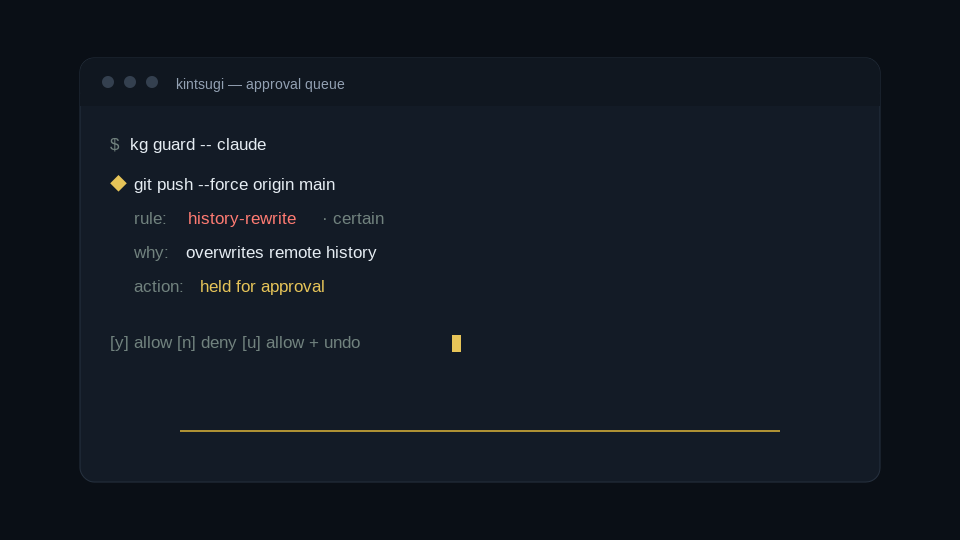
Kintsugi sits between your AI coding agent and the shell. Destructive commands are caught before they run, held for your approval, and made reversible, locally, every time.
$ curl -fsSL https://kintsugi.tools/install.sh | sh
macOS · Linux · kintsugi init to finish setup
Safety you can measure.
Deterministic by design
Every safety decision comes from deterministic rules. A model may explain what a command does, but it never decides whether the command is allowed. No judgment calls, no drift.
It reads the command, not keywords
A two-pass bash AST parser and tokenizer understand what a command actually does, including pipelines, substitutions, and obfuscation, instead of pattern-matching strings.
Held when it can't be sure
Ambiguous commands are held, never waved through. Kintsugi fails toward caution and never labels a catastrophic action as safe: rm -rf, DROP TABLE, git push --force, terraform destroy, dd, mkfs, secret reads, and more.
Undo is a command away
Copy-on-write snapshots capture what a command will touch. If something goes wrong, kintsugi undo puts it back, with no backup ritual and no guesswork.
A record you can't quietly edit
An append-only, hash-chained log in SQLite records every decision. Tampering with an entry breaks the chain, so you can trust the audit trail.
Your agent, your rules
A PATH shim and hooks work with Claude Code, Cursor, Codex, Qwen, Gemini, Copilot, OpenCode, and Google Antigravity. kintsugi test, dry-run, guard, and limits let you tune the edge before you trust it.
Between the thought and the shell.
Three steps, all on your machine, every time your agent reaches for a command.
Understand the command
A bash AST parser and tokenizer read what the command actually does, not just the words it contains.
Apply deterministic rules
Catastrophic actions are held. Ambiguous ones are held too. Nothing dangerous is ever waved through.
Snapshot, log, allow
A copy-on-write snapshot and hash-chained log entry are created before the command runs. Undo stays one command away.
One command. Then kintsugi init.
The installer puts the guard on your PATH and kintsugi init wires it into the agents you use. No account, no daemon phoning home.
$ curl -fsSL https://kintsugi.tools/install.sh | sh
Copied exactly · runs locally
$ kintsugi init
Enterprise controls (admin lock, passive recorder, TUI, and Control Room) are available for teams that need centralized policy.